
The following article about the cooling energy optimization for data centers has been recently accepted for publication by Energy. Wang, X., W. Peng, Z. Liu, C. Shen, X. Wang, D. Niu, Y. Wang, and J. Guo. Thermal-safety-constrained cooling energy optimization for data centers using a physics-informed graph surrogate model. Energy, accepted on October 21, 2026. More details will come soon once the paper is published.
The following article about the lightning occurrence over PEI has been recently accepted for publication by Atmosphere-Ocean. Fenech, A., X. Wang, and W. Gough. Lightning over Prince Edward Island (2000–2015): Atmospheric Controls, Seasonal Variability, and the Potential Modulating Role of Linear Infrastructure. Atmosphere-Ocean, accepted on October 21, 2026. More details will come soon once the paper is published.
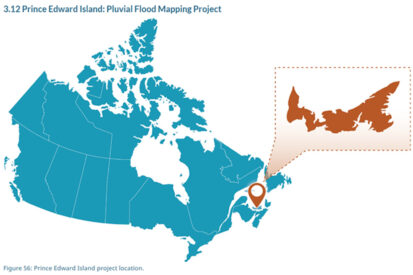
On October 9, 2026, Natural Resources Canada (NRCan) published the Volume 2 of the Case Studies on Climate Change in Flood Mapping from the Federal Flood Mapping Guidelines Series. The objective of this document is to help practitioners design and carry out a climate change assessment for flood hazard mapping and to highlight work that has been performed by flood mapping practitioners across the country to incorporate climate change into […]
Title: Stepwise Clustered Ensemble (SCE): An R package for interpretable and robust regression in environmental modeling Journal: Environmental Modelling & Software DOI: https://doi.org/10.1016/j.envsoft.2026.107152 Abstract: We present Stepwise Clustered Ensemble (SCE), an open-source R package for regression and inference designed to address key limitations of traditional random forest models. SCE replaces impurity splitting with a likelihood-based criterion using Wilks’ Λ statistic and adds a node-merging step to prevent superfluous partitions. This […]
The following article about an R software package based on stepwise cluster analysis has been recently accepted for publication by Environmental Modelling & Software. Li, K. L., M. Martin, X. Wang, and F. Hosseinpour. Stepwise Clustered Ensemble (SCE): An R Package for Interpretable and Robust Regression in Environmental Modeling. Environmental Modelling and Software, accepted on August 28, 2026. More details will come soon once the paper is published.
Dr. Wang’s recently published paper “Why are physics-based models taking so long to run?”, was selected by the Perspectives editorial board for featuring on AGU’s social media platforms. The post will be published on AGU’s X, BlueSky, Facebook, and LinkedIn accounts. It is worth to note that fewer than 2% of AGU papers are selected to be featured in this way.

The Government of PEI has recently released the Climate Hazard Video Series which explains the major climate hazards in PEI and what islanders should do to adapt to the changing climate. Dr. Wang is featured in several videos related to coastal erosion, coastal flooding, and the CHRIS (https://chris.peiclimate.ca). The Climate Hazard Video Series is available at: https://www.princeedwardisland.ca/en/information/land-and-environment/climate-hazard-and-risk-information-system-chris and https://www.youtube.com/watch?v=LFLKdlESXUA&list=PLXXhWkW9LcA6q29i8WHHpEUzqXytCNClE&index=1.
Title: Why Are Physics-Based Models Taking so Long to Run? Journal: Perspectives of Earth and Space Scientists DOI: https://doi.org/10.1029/2025CN000317 Abstract: Physics-based models provide a reliable and interpretable framework based on established physical laws, allowing them to deal with unforeseen future conditions much better than statistical data-driven methods. Physics-based models in Earth science (e.g., climate models, hydrological models, and groundwater models) are commonly used for understanding long-term trends, predicting near-term variations, […]
Title: Development of PXB-BVC Framework for Multivariate Flood-Risk Assessment Under Climate Change Journal: Remote Sensing DOI: https://doi.org/10.3390/rs18142275 Abstract: Flood risks are escalating under climate change, necessitating advanced methods to improve runoff prediction and multivariate flood-risk assessment. In this study, a physics–XGBoost-based Bayesian model averaging with bivariate copulas (PXB-BVC) framework was developed by integrating the Soil and Water Assessment Tool (SWAT), the Hydrologiska Byråns Vattenbalansavdelning (HBV) model, Extreme Gradient Boosting (XGBoost), […]
The following perspective paper about the long runtime needed for physics-based models in Earth sciences has been recently accepted for publication by AGU’s Perspectives of Earth and Space Scientists. Wang, X., Why are physics-based models taking so long to run? Perspectives of Earth and Space Scientists (AGU), accepted on June 30, 2026. More details will come soon once the paper is published.

Here in the Climate Smart Lab, we are a group of people developing sustainable climate solutions with cutting-edge technologies to help build climate-resilient communities. Collectively, we are working together with experts from all disciplines to build a climate-smart future for the next generation and many generations to come.