
The following paper about a framework for multivariate flood risk sssessment under climate change has been recently accepted for publication by Remote Sensing. Yang, A., W. Li, P. Gao, Y. Fan, and X. Wang. Development of PXB-BVC Framework for Multivariate Flood Risk Assessment under Climate Change. Remote Sensing, accepted on June 29, 2026. More details will come soon once the paper is published.
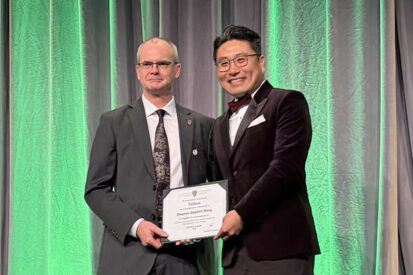
During the 2026 Annual Conference of Canadian Society for Civil Engineering (CSCE) held in Quebec City, Dr. Wang is awarded the Fellow of CSCE in recognition of his career achievements, contributions to civil engineering, and demonstrated leadership in the profession.
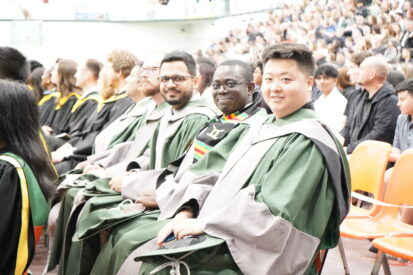
During the 2026 UPEI Convocation Week (May 12-15), four PhD graduates (Dr. Rana Ali Nawaz, Dr. Emmanuel Okine Neokye, Dr. Muhammad Qasim Mahmood, and Dr. Tianze Pang) and two MSc graduates (Lucy Li and Christine Parsons) are celebrated for their wonderful achievements. Dr. Rana Ali Nawaz (PhD in Sustainable Design Engineering) and Dr. Muhammad Qasim Mahmood (PhD in Environmental Sciences) are awarded the Faculty of Graduate Studies Awards of Distinction […]
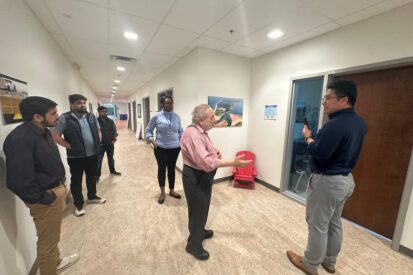
On May 7, 2026, Professor Emeritus Dr. Ron Baecker from the University of Toronto visited Climate Smart Lab and presented a research initiative for visualizing climate risks using 3D modeling and visualization technologies in order to increase public awareness of climate change and encourage real climate actions. An internationally recognized innovator, author, speaker, teacher, and mentor, Dr. Baecker co-founded the Dynamic Graphics Project (DGP), and founded the Knowledge Media Design […]
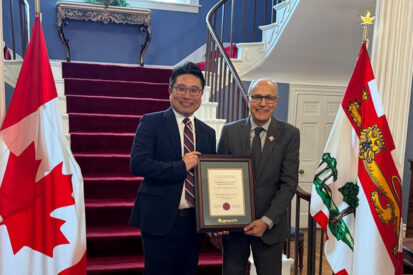
On March 4, 2026, Dr. Wang was awarded the Lieutenant Governor’s Award for Engineering Achievement by Engineers PEI. This award recognizes an outstanding engineering project involving Engineers PEI members. Dr. Wang received this award from the Lieutenant Governor of Prince Edward Island, the Honourable Dr. Wassim Salamoun, together with PEI Department of Land and Environment (previously PEI Department of Environment, Energy and Climate Action) for the pioneering and innovative project […]
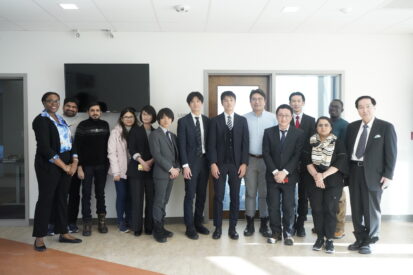
On January 21, 2026, a delegation from the Tokyo Metropolitan Environment Bureau and the Tokyo Climate Change Adaptation Center in Japan visited the Climate Smart Lab in the Canadian Centre for Climate Change and Adaptation at UPEI. Dr. Wang provided the delegation with an introductory presentation about the key research areas in the Climate Smart Lab, followed by a tour of the climate center, including a live demonstration of the […]
Title: Divergent occupational heat stress strategies required for Northern and Southern China under climate change Journal: International Journal of Biometeorology DOI: https://doi.org/10.1007/s00484-025-03113-0 Abstract: Observable climate change has led to an increase in compound heat events, thereby amplifying the economic impacts of labor heat stress and necessitating intervention strategies. Current research lacks high-resolution precision in projecting future heat stress and quantifying adaptation strategies, which is particularly critical for China given its […]
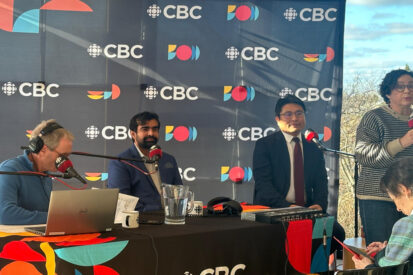
On November 20, 2025, Dr. Xander Wang joined the CBC Maritime Noon as a panelist to discuss about coastal erosion and climate change in PEI during a special event hosted in the Canadian Centre for Climate Change and Adaptation at UPEI. In the morning of November 20, Dr. Wang also offered a live demonstration of the lab-scale coastal and inland flood simulator to the visitors from PEI Watershed Alliance and […]
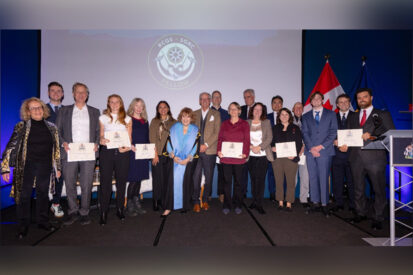
On November 4, 2025, Dr. Xander Wang was officially inducted as a Fellow of Royal Canadian Geographical Society (RCGS) during the AGM of RCGS in its headquarters at 50 Sussex Drive in Ottawa. RCGS fellows are remarkable Canadians from scientists and educators to artists and adventurers, whose achievements and curiosity advance the society’s mission of exploration, education, and making Canada more known to Canadians.
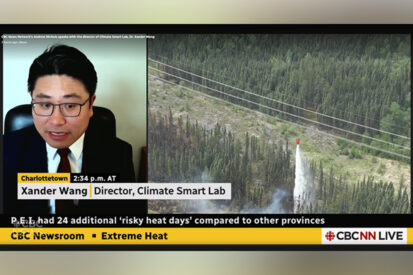
In the afternoon of September 17, 2025, Dr. Wang was interviwed by the CBC News Network’s Andrew Nichols to discuss the extreme heat that PEI has experienced in recent years due to climate change. According to Environment and Climate Change Canada, every Canadian province and territory experienced at least 10 ‘risky heat days’ added due to climate change. PEI experienced the greatest number (24 days) of ‘risky heat days’ added […]

Here in the Climate Smart Lab, we are a group of people developing sustainable climate solutions with cutting-edge technologies to help build climate-resilient communities. Collectively, we are working together with experts from all disciplines to build a climate-smart future for the next generation and many generations to come.